CLI
The curator binary is the whole operational surface. Query commands
are thin shells over the same engine the MCP tools ride, so
curator search and kp_search cannot drift apart.
curator --help prints the canonical usage text; this page is that
text, expanded. Every command exits 0 on success, 1 on failure
(message on stderr), 2 on usage errors.
Commands
| command | does |
|---|---|
init [dir] | scaffold a vault: curator.toml, .kp/, now.md, first index |
ingest | run producer adapters (Curio, vault notes) into the vault/index, incrementally |
index rebuild | rebuild index.db (blue/green epoch swap); reindex is an alias |
zotero sync | two-channel Zotero sync into the vault (delta metadata + fulltext) |
search | hybrid retrieval from the terminal |
get | one note by id (any namespace) — content + metadata |
related | embedding-nearest notes to a note |
recent | recently ingested/changed notes |
mcp serve | serve the MCP surface (stdio default; --http + bearer) |
propose | create a proposals/v1 changeset from a directory of files |
review [<id>] | interactive TUI — Review · Search · Digest (no id), or render one proposal |
apply <id> | validate and apply a proposal (stamps applied/rejected) |
reject <id> | reject an open proposal without applying it (stamps rejected) |
proposals list | list stored proposals and their status |
digest run | run the deterministic librarian digest (--auto to apply) |
doctor | config / vault / index / cursors health |
status | vault + index + proposals snapshot (always succeeds; --json) |
-h, --help / -V, --version | usage / version |
Shared flag on every command that loads config:
--config <path> — config location (default: $CURATOR_CONFIG or
$KP_CONFIG, then ./curator.toml, ./kp.toml —
discovery details). Batch and query commands
also take --json for machine-readable output on stdout.
curator init
curator init [dir] [--embedder builtin|hash]
Scaffolds dir (default .) as a Curator vault: writes
curator.toml from the shipped example pointed at the directory
(never overwriting an existing curator.toml or legacy kp.toml),
creates the proposals directory and a starter now.md, and builds the
first index by running a full ingest.
| flag | meaning |
|---|---|
--embedder <e> | builtin | hash, stamped into the scaffolded config. builtin fetches its pinned ~130 MB ONNX model on first use (one-time, announced); hash is offline and deterministic (no ML) |
curator ingest
curator ingest [--config <path>] [--json]
Incremental: full-file hashes mean unchanged notes cost nothing;
changed notes are re-chunked and re-embedded; frontmatter-only edits
update metadata without re-embedding. Reports counts for
ingested/unchanged/skipped/ignored/removed notes and links; with
[curio].enabled, also folded/duplicate/malformed event counts.
curator index rebuild
curator index rebuild [--config <path>] [--json] # alias: curator reindex
Rebuilds the same corpus, identities, and chunks that incremental ingest produces, blue/green-swapped in as a new epoch — see Operations for when and why.
curator zotero sync
curator zotero sync [--config <path>] [--json]
                    [--dir <path>] [--no-fulltext] [--fulltext-cap <n>]
| flag | meaning |
|---|---|
--dir <path> | vault-relative notes dir (default: zotero) |
--no-fulltext | skip the fulltext pass |
--fulltext-cap <n> | fulltext truncation cap, characters (default: 20000) |
Two-channel sync — how it works.
curator search
curator search <query> [--k <n>] [--mode hybrid|vector|fts]
               [--config <path>] [--json]
| flag | meaning |
|---|---|
--k <n> | result count (default 10) |
--mode <m> | hybrid (default) | vector | fts |
--json | print the MCP-shaped JSON output (kp_search's shape) |
curator get
curator get <id> [--config <path>] [--json]
<id> accepts every identity namespace: curio:…, zotero:…,
kp:…, path:<vault-relative-path>.
curator related
curator related <id> [--k <n>] [--config <path>] [--json]
Embedding-nearest notes to the anchor note (anchor excluded).
curator recent
curator recent [--days <n>] [--kind curio|zotero|kp|path]
               [--config <path>] [--json]
| flag | meaning |
|---|---|
--days <n> | look-back window in days (default 7) |
--kind <ns> | identity-namespace filter |
curator mcp serve
curator mcp serve [--config <path>] [--http]
Serves MCP surface v1. stdio by default; --http (or
[mcp].transport = "http") serves streamable HTTP on
[mcp].http_bind and requires the bearer token env named by
[mcp].bearer_token_env — the server refuses to start without it.
curator propose
curator propose --title <t> --from <dir>
                [--rationale <r>] [--author <a>]
                [--config <path>] [--json]
| flag | meaning |
|---|---|
--title <t> | proposal title (required) |
--from <dir> | directory of generated files; every file maps to the same vault-relative path (required) |
--rationale <r> | why this change (default: empty) |
--author <a> | proposal author (default: curator-cli) |
Generated-content is the only creation mode in v1; a staged-changes mode (diffing working-tree edits) is planned, not yet implemented.
curator review / apply / reject / proposals list
curator review            # the interactive TUI (Review · Search · Digest) — a TTY
curator review <id>       # human-readable render of one changeset (scriptable)
curator apply <id>        # validate -> apply -> stamp status
curator reject <id>       # stamp an open proposal rejected, writing nothing
curator proposals list    # ids, status, titles, file counts
apply runs the deterministic validator
(hard-reject list)
and stamps applied/rejected. A failed apply also stamps rejected;
reject is the reviewer saying "no" up front — same one-way guard (only an
open proposal can be rejected), but nothing is written.
The interactive TUI. curator review with no id and a terminal opens a
tabbed full-screen app — three screens over your vault. Tab / Shift-Tab
or 1 2 3 switch screens, ? toggles a key reference, q quits
(Ctrl-C anywhere; Esc is back / cancel / close-preview). The index and
embedder load lazily — a review-only session never opens them, so the app
starts instantly.
Review
The proposal queue: the selected changeset's metadata and a coloured diff, with a pre-flight banner that checks — non-destructively — whether the patch still applies cleanly against the current vault, so drift is visible before you commit (apply is destructive-on-reject). Apply and reject both confirm.
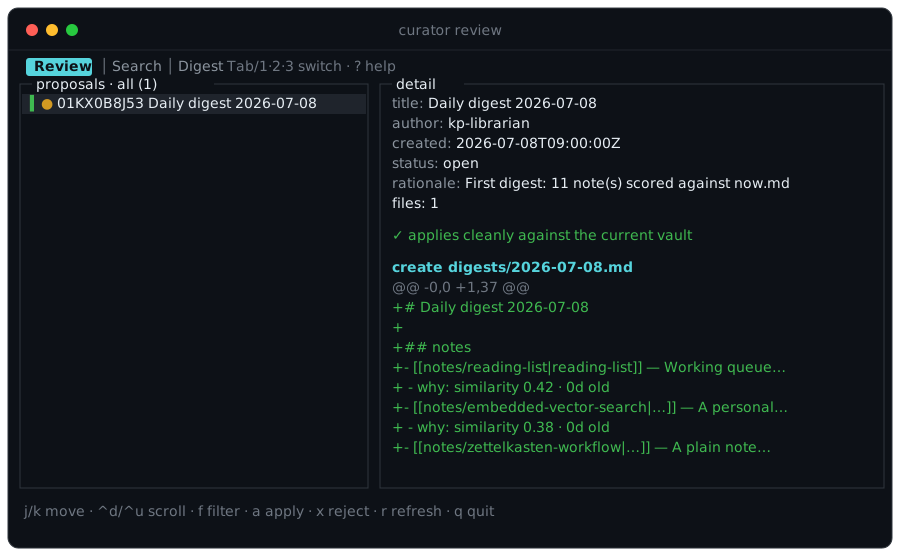
| key | action |
|---|---|
j / k, ↑ / ↓ | move between proposals |
Ctrl-d / Ctrl-u, PgDn / PgUp | scroll the diff |
f | cycle the status filter (all → open → applied → rejected) |
a / x | apply / reject the selected proposal (confirm with y/n) |
r | refresh the queue from disk |
Search
Interactive hybrid retrieval over the same KpEngine the MCP surface and
curator search ride — so it cannot drift from them. Type a query and press
↵; move through the ranked hits; open a note's full content, or jump to its
embedding-nearest neighbours.
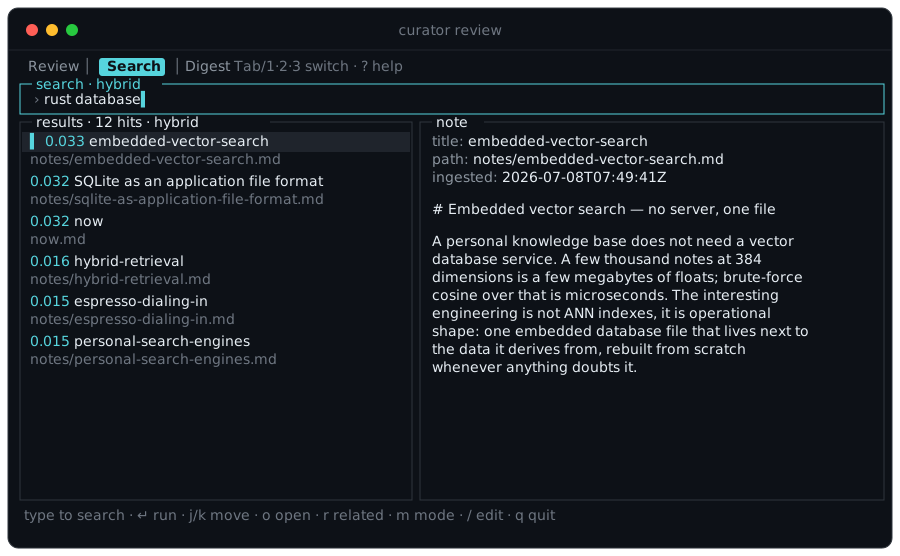
| key | action |
|---|---|
type · ↵ | edit the query · run it |
j / k | move through the results |
o / ↵ | open the selected note · ^d/^u scroll it |
r | related — embedding-nearest to the selection |
m | cycle mode (hybrid → vector → fts) and re-run |
/ or i | jump to the query box · Esc closes the preview / returns |
Digest
A read-only preview of what the deterministic librarian would surface right now — ranked candidates with scores and why-surfaced reasons — and a one-key generate that files today's digest as a proposal (which lands on the Review tab to apply or reject). It writes nothing until you generate.
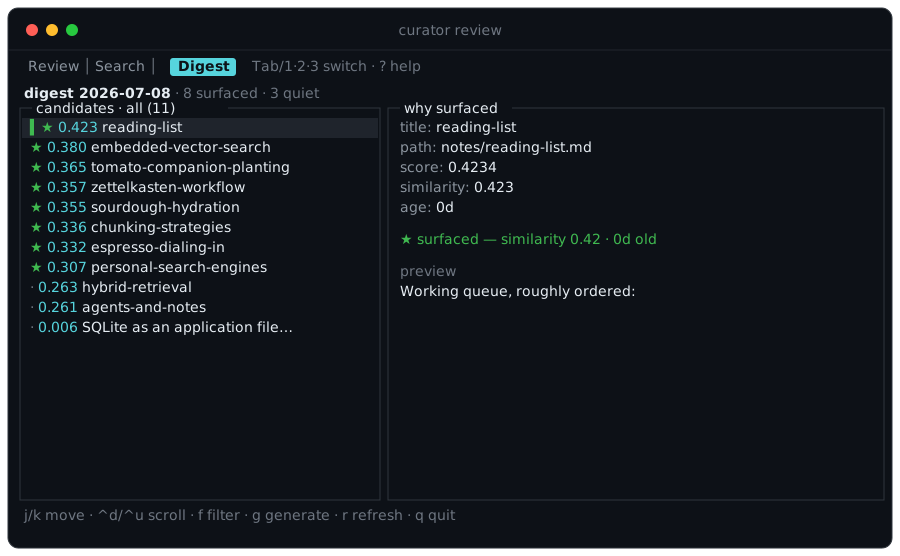
| key | action |
|---|---|
j / k | move · ^d/^u scroll the preview |
f | cycle the filter (all → surfaced → quiet) |
g | generate today's digest (confirm with y/n) |
r | refresh the preview from the index |
Run without a terminal (piped/CI), curator review prints guidance and exits
0 rather than blocking — pass an <id> for the non-interactive render.
curator digest run
curator digest run [--auto] [--now <rfc3339>] [--config <path>] [--json]
| flag | meaning |
|---|---|
--auto | auto-apply the digest proposal when the gate admits it (pure additions under [librarian].digest_dir, kp:<uuidv7> identities) |
--now <rfc3339> | inject the clock (testing/reproducibility; default: now) |
curator doctor
curator doctor [--config <path>] [--json]
Checks config, vault, proposals queue, now.md, index meta +
embedder identity match, digest log, Curio cursors, and MCP transport
sanity. Levels ok/warn/error; exits nonzero when anything
errors — healthcheck-ready
(operations guidance).
curator status
curator status [--config <path>] [--json]
A state snapshot — the counterpart to doctor's health checks. Reports
the vault note count, the serving index epoch/embedder/note count, the latest
librarian digest, the proposal queue (total + open), and the MCP transport.
Unlike doctor it never fails: a not-yet-built index is reported as not built, not an error, so status --json is safe to pipe into scripts.