TASTE — the model's mind
Four views of one posterior: where your patches sit, what your styles are, what each one listens for, and whether any of it should be believed.
TASTE is full-screen and read-only. Nothing here changes the model; it is the model reporting on itself.
The style chips across the top are shared by all four tabs. Each carries a generated name, its share of the bank, and a ▸ that auditions that style's exemplar. Click a chip's name to rename it. The name persists and is used everywhere the style is mentioned.
MAP
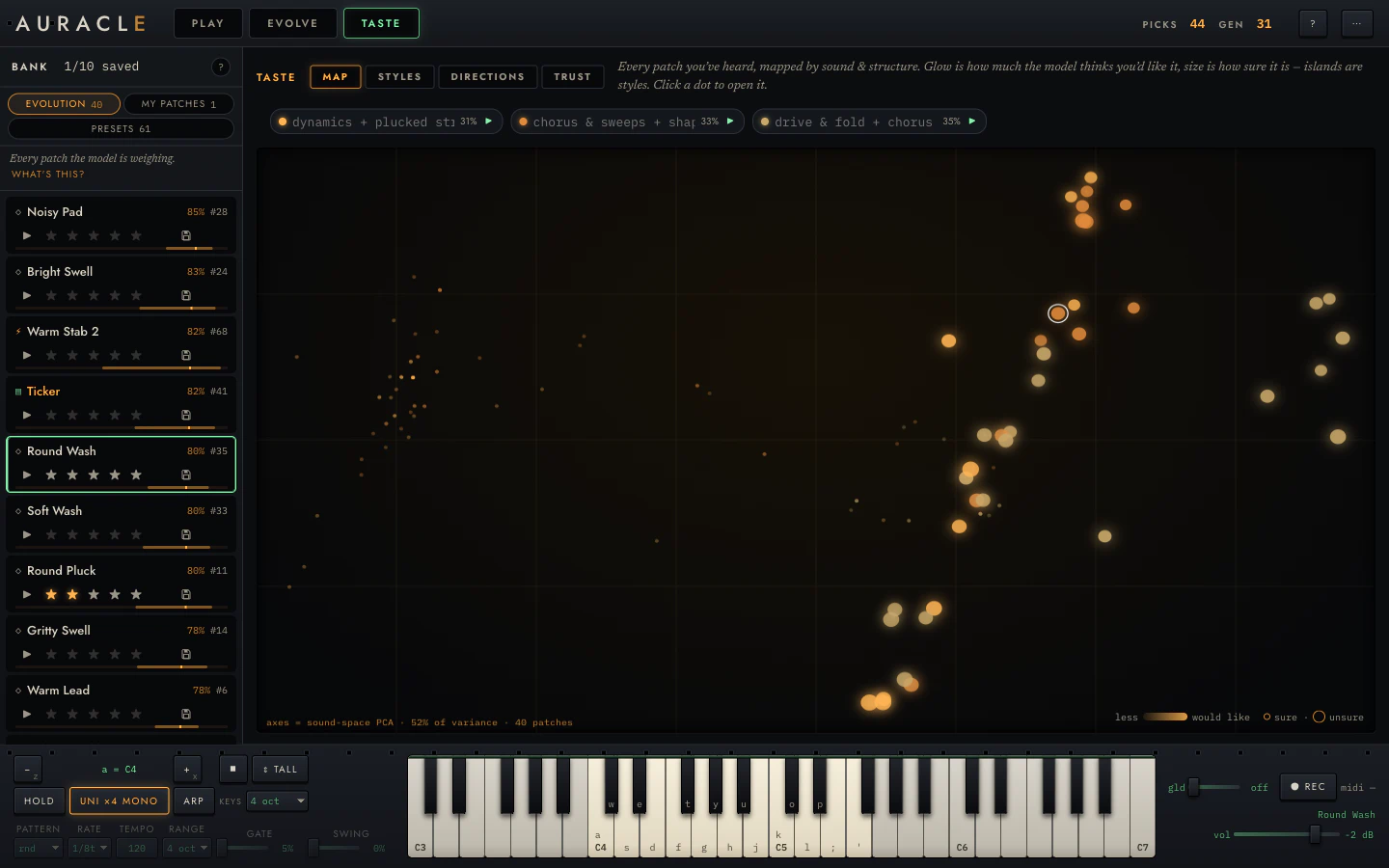
Every patch you have heard, placed by sound and structure. It is a 2D projection (principal components of the feature space), and the footer tells you how much of the variance those two axes capture, typically around half. Worth knowing before you read too much into a distance.
The orientation is pinned, so the map does not mirror itself between one recompute and the next — somewhere you recognise stays where you left it. The axes themselves still turn slowly as your taste and the bank move, because they are computed from the patches you have actually heard.
| Channel | Means |
|---|---|
| Glow | Posterior mean utility — how much it thinks you would like it |
| Size | Posterior uncertainty — how sure it is |
| Hue | Which style lens claims it |
The size channel is easy to miss and it is the useful one. A big dim dot is "I have no idea about this". A small bright dot is "I am confident you like this". Early in a session everything is big; that is what a cold start looks like.
Click any dot to open that patch on the workbench.
STYLES
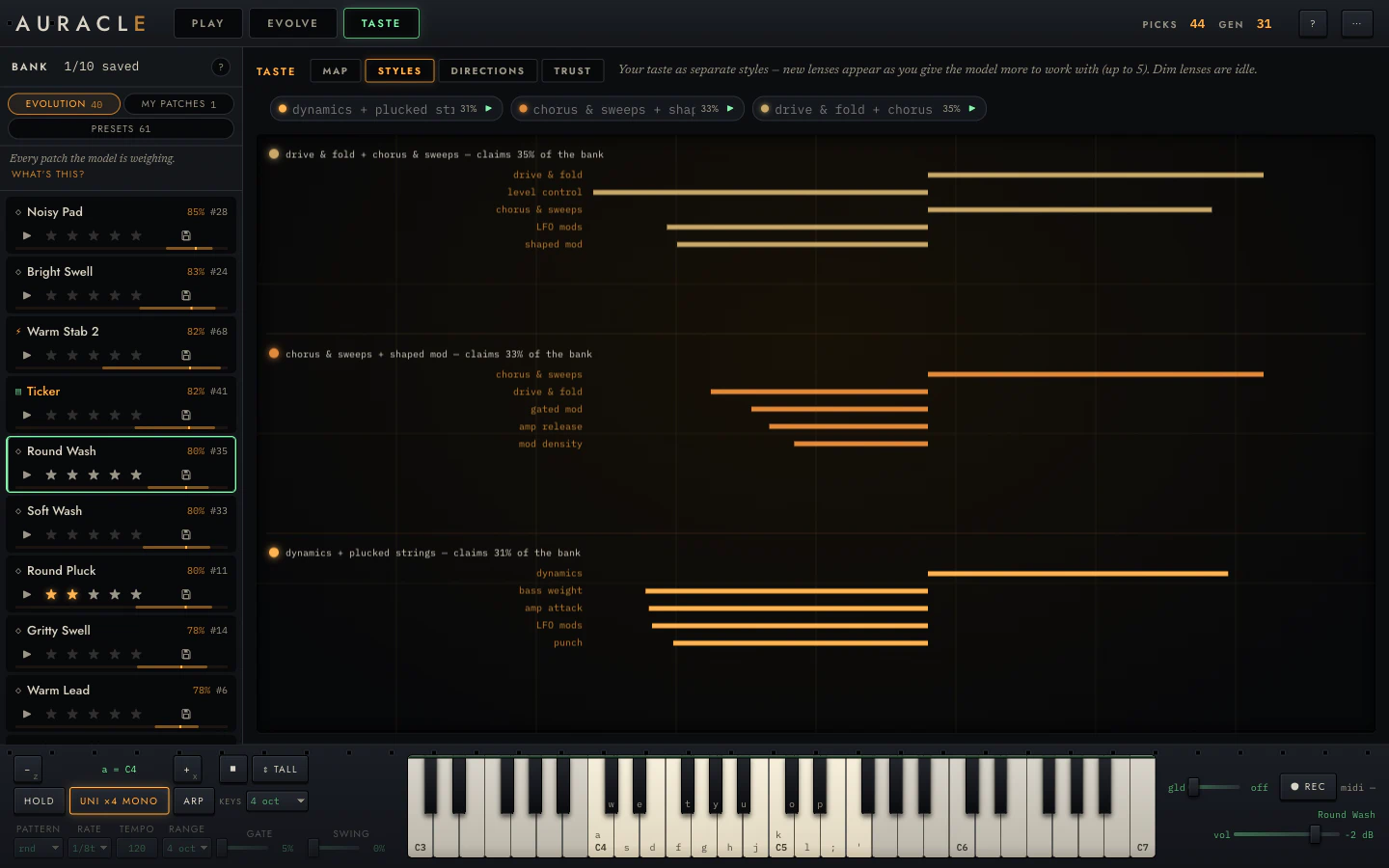
Your taste as separate lenses. Each shows its name, the share of the bank it claims, and its strongest coordinates.
This exists because taste is not one direction. You are allowed to like dark drones and bright plucks, and a single linear model would average them into a preference for neither. Auracle fits up to five lenses and scores every patch as its best lens's opinion, so a duel across two islands is still a well-formed comparison.
Lenses appear as evidence arrives. Early on you will have one; more separate out as the model finds structure it cannot explain with fewer. A dim lens claiming almost none of the bank is idle. Your taste has fewer islands than the model has capacity for, which is common and not a fault.
DIRECTIONS
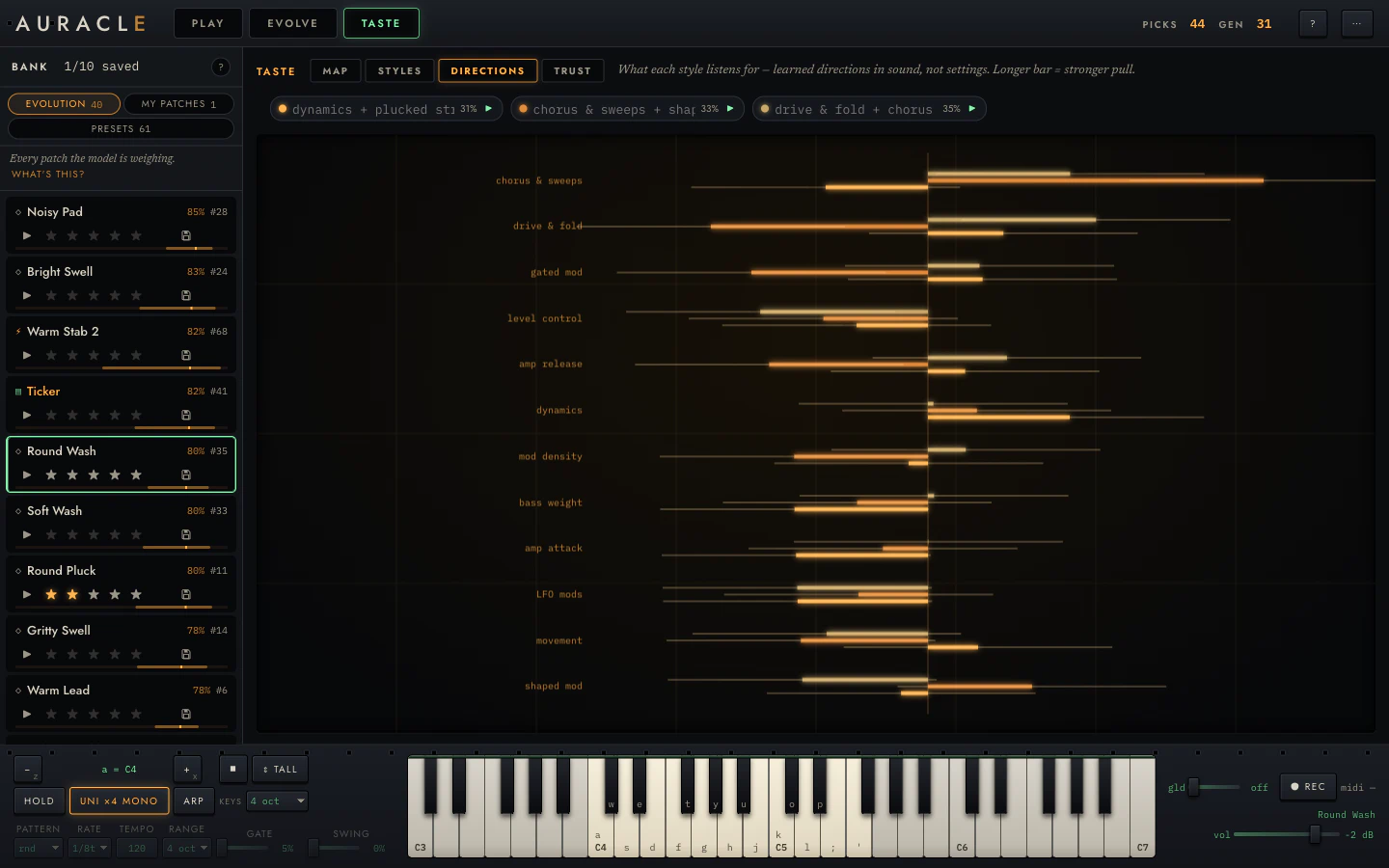
What each lens listens for, coordinate by coordinate. Bar length is the weight; the thin whisker behind it is the credible interval.
Read the whiskers, not the bars. A long bar with a whisker that crosses the centre line is a coefficient the model has not established: a guess that happens to be pointing somewhere. A short bar with a tight whisker is a real, small preference. Both are shown, because hiding the uncertainty is how a model starts sounding more certain than it is.
The coordinates are named in perceptual and structural terms: chorus & sweeps, drive & fold, bass weight, amp attack, mod density. What each one measures is in the reference.
TRUST — is its confidence honest?
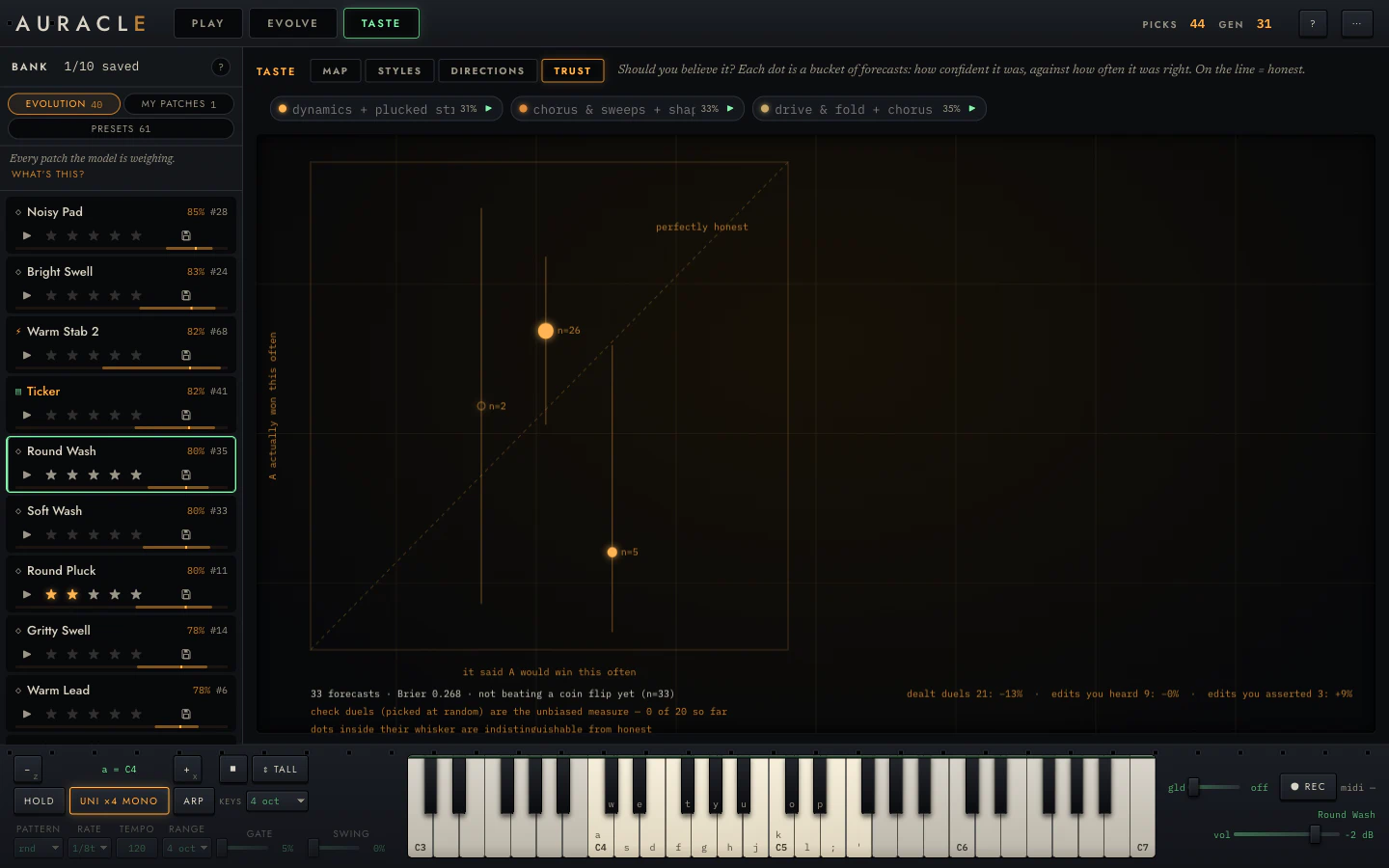
This is the tab that makes the rest trustworthy.
Every duel is forecast before you answer it. The model commits to a probability that A wins, then your answer arrives. Those are out-of-sample, one-step-ahead predictions, and this diagram scores them: the dashed diagonal is the model's claim, each dot is what happened at that confidence level, and the whisker is how much a bucket that size could wobble by chance.
Underneath, the numbers:
- Brier score. Mean squared error of the forecasts. Lower is better;
0.25is what always saying "50/50" scores. Reported as skill against that baseline, so0means no better than a coin and1means perfect. - check duels. The same score restricted to the randomly-drawn probes. This is the number without an asterisk.
- hit rate. Kept so you can see how misleading it is.
Because accuracy is not a proper scoring rule, and here it would lie. A model that says 0.51 every time and is right 51% of the time scores exactly like one that says 0.99 and is right 51% of the time. Worse, an information-seeking pairing rule deliberately asks near-ties, so the hit rate is pinned near 50% by construction: a perfectly calibrated model would look like a coin flip and you would conclude it had learned nothing. Brier skill moves when sharpness improves, which is what you want to watch.
Split out at the right, the same scores by where the answer came from: dealt duels, edits you heard, edits you only asserted. A hand edit you committed after listening and one you committed by ticking my edit is better make the same claim in the log, and there is no reason to assume they are equally reliable. This is how you find out.
"Not beating a coin flip yet (n=33)" is the correct thing to see early. It means the display is honest and you have not yet given it enough to work with. Keep duelling.