Auracle
A playable modular synthesizer that learns what you like, and can show you what it learned.
Auracle generates patches by evolutionary search, plays them to you, and asks which one you prefer. From your answers it fits a model of your taste, with uncertainty you can inspect, and uses it to steer the search. Over a session it stops guessing and starts proposing.
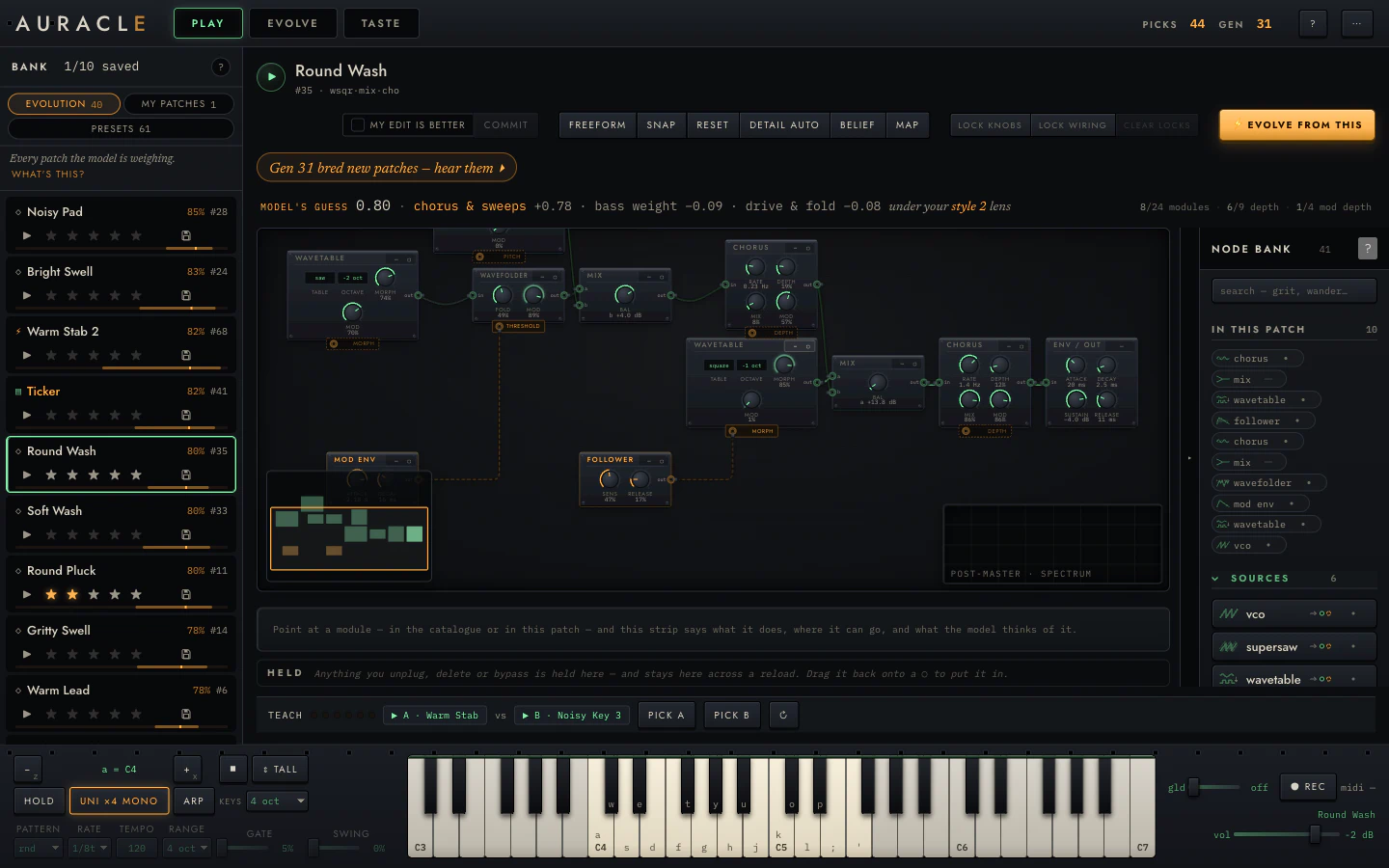
It is also just a synthesizer. Four-voice polyphony, a keyboard, MIDI, an arpeggiator, a patchable rack with typed cables and forty-one modules. You can ignore the model entirely and play it like an instrument.
What makes it different
Sound design tools usually make you choose. Presets and randomizers are fast and shallow: you audition until something works, and nothing accumulates. Patching from scratch is deep and slow. Genetic-algorithm synths tried to bridge the gap with star-a-generation workflows, but they forget everything between sessions and cannot tell you why they suggest what they suggest.
Auracle treats the problem as inference instead:
- Every patch is a term in a typed grammar: a tree whose types are signal kinds. Every mutation, every crossover and every edit you make by hand produces a patch that is still valid and still playable.
- Your taste is a model with a posterior. It is built from a handful of independent style lenses, so you are allowed to like several unrelated things. It carries uncertainty, and it predicts every vote before you cast it, so you can check whether it was right. The TRUST tab is where it reports on itself.
- The search proposes toward you. What the model learns reshapes how evolution proposes, not only how it scores. Lock the parts you love and refinement leaves them alone.
- One compiler serves both. The patch you play live is the same one that was evolved, vetted and measured. There is no separate "render version".
For the machinery rather than the workflow, see the Reference, which carries the math.
The shape of a session
Three views, one loop between them.
| View | Shows | What you do there |
|---|---|---|
| PLAY | the patch | Hear it, play it, turn its knobs, rewire it, lock what you like |
| EVOLVE | the question | Two candidates; pick one. This is what teaches it |
| TASTE | the answer | What it thinks your taste is, how sure it is, whether it has been right |
You will spend most of your time in PLAY and EVOLVE. TASTE is where you go to find out whether it is working.
Open it, pick 3 of 9 presets when it asks, then answer duels in EVOLVE. After a dozen or so picks press EVOLVE POOL and listen to what it bred. That is the whole loop.
What to expect
Auracle is pre-1.0. The instrument is finished enough to play for hours and the taste loop is closed end to end, but:
- It takes real evidence to learn anything. A handful of duels is not a taste model. Expect the first useful proposals after a dozen or two picks, and confident ones considerably later. From a cold start it takes hundreds of duels, which is why the three-pick warm start exists.
- It will tell you when it does not know. Early on, TRUST will say the model is not beating a coin flip. That is the display working, not failing.
- The save format may change between versions. Your session lives in your browser and there is a migration path, but export anything you care about.
- Desktop only, for now. A phone or small tablet gets a stand-in screen instead; see browser support.
Where to go next
- Never used it → Your first session
- Want it running locally or offline → Running it yourself
- Already playing, want the key map → Keyboard and MIDI
- Want to know how it works → the Reference
- Something is wrong → Troubleshooting